

Introducing Forbidden City
The Forbidden City, which served as the royal residence for the emperors of the Ming and Qing dynasties from the 15th to 20th century, was once the center of State power in late feudal China. Built between 1406 and 1420 by the Ming emperor Zhu Di, it was home to 14 Ming and 10 Qing emperors over a period of 505 years. The Forbidden City houses over a million rare and valuable works of art, including paintings, ceramics, seals, steles, sculptures, inscribed wares, bronze wares, enamel objects, and more. In 1987, it was declared a World Heritage Site by UNESCO and is recognized as the largest collection of preserved ancient wooden structures in the world.
Forbidden City Fast Facts
• AKA: Palace Museum
• Chinese Name: Gu Gong Bo Wu Yuan 故宫博物院
• Best Time to Visit: All year around
• Recommended Visiting Hours: About 2 to 3 hours
• Opening Hours: 8:30 – 17:00 (Apr – Oct), 8:30 – 16:30 (Nov – Mar)
• Entrance Fee: CNY60 (Apr – Oct), CNY40 (Nov – Mar); CNY10 (Treasure Gallery), CNY10 (Clocks and Watches Gallery)
• Address: No. 4 Jingshanqian Street, Dongcheng District, Beijing
What UNESCO Says on the Forbidden City
As the royal residences of the emperors of the Ming and Qing dynasties from the 15th to 20th century, the Imperial Palaces of the Ming and Qing dynasties in Beijing were the centre of State power in late feudal China. The Imperial Palace of the Ming and Qing Dynasties in Beijing known as the Forbidden City was constructed between 1406 and 1420 by the Ming emperor Zhu Di and witnessed the enthronement of 14 Ming and 10 Qing emperors over the following 505 years.
The Forbidden City, located in the centre of Beijing is the supreme model in the development of ancient Chinese palaces, providing insight into the social development of late dynastic China, especially the ritual and court culture. The layout and spatial arrangement inherits and embodies the traditional characteristic of urban planning and palace construction in ancient China, featuring a central axis, symmetrical design and layout of outer court at the front and inner court at the rear and the inclusion of additional landscaped courtyards deriving from the Yuan city layout. As the exemplar of ancient architectural hierarchy, construction techniques and architectural art, it influenced official buildings of the subsequent Qing dynasty over a span of 300 years. The religious buildings, particularly a series of royal Buddhist chambers within the Palace, absorbing abundant features of ethnic cultures, are a testimony of the integration and exchange in architecture among the Manchu, Han, Mongolian and Tibetan since the 14th century. Meanwhile, more than a million precious royal collections, articles used by the royal family and a large number of archival materials on ancient engineering techniques, including written records, drawings and models, are evidence of the court culture and law and regulations of the Ming and Qing dynasties.
Reasons to Visit the Forbidden City
• The Forbidden City is a World Heritage Site declared by UNESCO in 1987.
• The Forbidden City served as the imperial palace, the center of politics, and the seat of power during the Ming and Qing Dynasties from 1420 to 1912.
• The Forbidden City was the home of the Chinese emperors of the Ming and Qing dynasties for over 500 years.
• The Forbidden City is the only existing imperial architectural complex in China, showing the supreme techniques and craftsmanship on construction.
• The Forbidden City is home to a vast collection of Chinese art and artifacts (1.8 million in total).
• The Forbidden City is a living museum that tells the story of China’s rich and complex history.
What to Expect at the Forbidden City
Layout & Construction
Extending 750 meters east-west and 960 meters north-south, the 720,000 square-meter city is the largest palatial complex in the world. The whole complex is tightly guarded by two defense lines. One is the moat, which is 52 meters wide and six meters deep, and the other is the city wall, which is 3 kilometers in length, 10 meters in height and 8.62 meters in the width at the bottom.
There are four gates in the Forbidden City: Wumen (the Meridian Gate) to the south, Shenwumen (Gate of Devine Prowess) to the north, Donghuamen to the east and Xihuamen to the west. On the four corners stand four turret towers, each with three layers of eaves and 72 ridges.
The Forbidden City is divided into southern and northern parts: The former served as the emperors’ work area and the latter as his living quarters. The main structures are arranged along a central axis, and the buildings on both sides of it are symmetrical.
The main structures in the work area are the Hall of Supreme Harmony, the Hall of Central Harmony and the Hall of Preserving Harmony. All three main halls are built on an eight-meter-high platform covering a total area of about 85,000 square meters. The Hall of Supreme Harmony is the largest and most imposing hall. Behind the Hall of Supreme Harmony is the Hall of Central Harmony, where the emperors used to rest and receive officials before attending major ceremonies. The northernmost structure is the Hall of Preserving Harmony, in which the emperor held banquets and interviewed successful candidates for imperial examinations.
The living quarters include the Palace of Heavenly Purity, Hall of Union and Palace of Earthly Tranquility and the six lesser halls on the east and west sides, which together are called “three main halls and six lesser halls”, where the emperor and his concubines lived. North of the living quarters is a small but exquisite imperial garden.
Meridian Gate
The Meridian Gate is the southern entrance to the Forbidden City and its largest and most significant gate. Measuring 37.95 meters (124.5 feet) in height and 60.05 meters (198 feet) in width, it features five arches, with the central one reserved exclusively for the emperor. The remaining arches were used by officials, members of the imperial family, and the general public. Constructed in 1420 during the Ming Dynasty, the Meridian Gate was where the emperor would annually announce the new lunar calendar.”
Gate of Supreme Harmony
The Gate of Supreme Harmony is the primary entrance to the Outer Court of the Forbidden City. Situated at the northern end of the Meridian Gate, it measures three bays deep and seven bays wide. The gate is accompanied by two smaller gates, with Zhendu Gate to its west and Zhaode Gate to its east. The emperor would hold court and receive foreign ambassadors here, and it was also the site of significant ceremonies such as coronations and weddings.
Hall of Supreme Harmony
The Hall of Supreme Harmony is the largest and most important hall in the Forbidden City. It is located behind the Gate of Supreme Harmony and was built in 1420 during the Ming Dynasty. The hall is made of red sandalwood and features a golden roof. Measuring 60.1 meters wide, 33.33 meters deep, and 35.05 meters high, it was the site of many significant ceremonies during the feudal dynasties, including the emperor’s coronation and wedding, as well as the conferring of titles and issuing of orders for expeditions. The Hall of Supreme Harmony was erected in 1420 during the Ming Dynasty and served as the location where the emperor held court and received foreign ambassadors. The hall was also used for important ceremonies, such as the emperor’s coronation and wedding.
Hall of Central Harmony
The Hall of Central Harmony is situated behind the Hall of Supreme Harmony. Built in 1420 during the Ming Dynasty, the Hall of Central Harmony was used for significant ceremonies such as the emperor’s birthday and the enthronement of new emperors, as well as for banquets and other celebrations.
Hall of Preserving Harmony
The Hall of Preserving Harmony is the third and final main hall in the Outer Court of the Forbidden City. It is situated behind the Hall of Central Harmony. Constructed in 1420 during the Ming Dynasty, the Hall of Preserved Harmony was used for rehearsals of significant ceremonies such as the emperor’s coronation and wedding, as well as for the final stage of the Imperial examination.
Gate of Heavenly Purity
The Forbidden City is divided into two parts by the Gate of Heavenly Purity, which is the main gate of the Inner Court. The gate is located on the central axis and is three bays deep and seven bays wide. It is accompanied by two minor gates, Zhendu Gate to the west and Zhaode Gate to the east. The Gate of Heavenly Purity was built in 1420 and reconstructed in 1655. During the Qing Dynasty, emperors used this gate to hold court.
Palace of Heavenly Purity
The Palace of Heavenly Purity is the largest palace in the Inner Court of the Forbidden City. It is situated behind the Gate of Heavenly Purity. The palace was originally constructed in 1420, rebuilt in 1798 due to fire damage. It served as the residence and workplace of Ming emperors and the first two Qing emperors, where they conducted daily affairs of state, read and signed documents, and met with ministers and envoys. The palace was also used for banquets and other ceremonies on occasion.
Hall of Celestial and Terrestrial Union
The Hall of Celestial and Terrestrial Union is located between the Palace of Heavenly Purity and the Palace of Earthly Tranquility. The Hall of Celestial and Terrestrial Union was built in 1420 during the Ming Dynasty, and was restored twice in 1655 and in 1669. In 1797, it was damaged by a fire and thus rebuilt the next year. It was used for the emperor’s private audiences and for important ceremonies, such as the emperor’s birthday and the enthronement of new emperors.
Palace of Earthly Tranquility
The Palace of Earthly Tranquility is the northernmost palace in the Inner Court of the Forbidden City. It is situated behind the Hall of Celestial and Terrestrial Union. Originally built in 1420, it was rebuilt in 1605 after being destroyed by fires in 1514 and 1596. It underwent three additional restorations in later years. During the Ming Dynasty, it served as the primary residence for the empress and her family and was used for significant ceremonies such as the empress’s birthday and the birth of imperial heirs. After being reconstructed during the Qing Dynasty (1644-1911), it was used as both the nuptial chamber for the emperor and empress and as an altar for worshipping Shamanism deities.
Hall of Mental Cultivation
The Hall of Mental Cultivation is a small palace situated on the west side of the Palace of Heavenly Purity. It gained particular importance during the Qing Dynasty. Initially intended to serve as a temporary resting place for emperors, it became the permanent bedchamber for Emperor Yongzheng and was subsequently used by eight emperors until the end of the Qing Dynasty. The hall is divided into two sections: a front hall, which served as the emperor’s office, and a rear hall, which was used as his bedroom.
Imperial Garden
The Imperial Garden, located outside the Gate of Terrestrial Tranquility, was built in 1417 during the Ming dynasty. It is a rectangular garden measuring approximately 12,000 square meters. This garden was a private retreat for the imperial family and is a prime example of Chinese imperial garden design. It features around twenty structures, each with its own unique style, that blend harmoniously with the trees, rockeries, flower beds, and sculptural objects. Visitors are often delighted and amazed by the artistry of the designers who were able to achieve so much in such a small space.
Gate of Divine Prowess
The Gate of Divine Prowess is the northern gate of the Forbidden City. It was originally built in 1420 during the reign of Emperor Yongle. The gate was initially named the Black Tortoise Gate, but was later renamed to the Gate of Divine Prowess during the Qing Dynasty. The gate served as the back gate of the palace and was used by palace workers. Women who were being sent into the palace for selection as concubines also entered through this gate.
How to Get to Forbidden City
By Metro
• Take subway line 1 to Tiananmen East Station (Exit B) or Tiananmen West Station (Exit B), walk 500 meters (550 yards) to the Tiananmen Tower, and then walk north to the Meridian Gate.
By Bus
• Take a bus to Tiananmen East Station. The buses that go there are 1, 2, 52, 59, 82, 120.
• Take a bus to Tiananmen West Station. The buses that go there are 1, 5, 52.
Additional Travel Advice on Forbidden City
• Please wear comfortable shoes for it normally takes over 2 hours for the visiting.
• The Forbidden City carries out a south-to-north unidirectional itinerary. Visitors can only enter it through the Meridian Gate (Wumen) and exit from the Gate of Divine Prowess (Shenwumen) or Donghuamen.
• Smoking is forbidden in the Museum.
Grid List
Tour Highlights
• Feel the heartbeat of China at Tiananmen Square, the largest city square in the world.
• Explore the Forbidden City, home to 24 Chinese emperors and their households for almost 500 years.
• Enjoy a commanding view of the Forbidden City and Beijing from the top of Jingshan Park.
• Discover Temple of Heaven where Emperors of Ming & Qing dynasties pray to Heaven for good harvest.
• Hike along Jinshanling Great Wall, the best preserved part of Ming Dynasty wall with many original features.
• Step into Puning Temple to admire the world's tallest wooden sculpture of the Bodhisattva Avalokiteśvara.
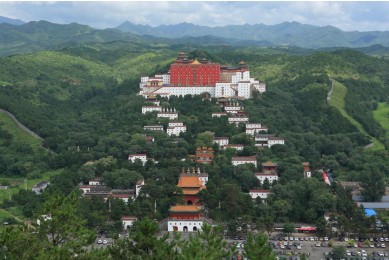
• Discover Putuo Zonghseng Temple, modeled after the Potala Palace of Tibet & nicknamed the Little Potala Palace.
• Wander through the Mountain Resort, the largest existing imperial palace-garden and temple complex in China.
• Admire Summer Palace, the best preserved imperial garden in the world, and the largest of its kind in China.
• Marvel at Bird Nest & Water Cube, two architectural icons from the 2008 Beijing Olympic.
Tour Itinerary at a Glance
• Day 1 Arrival in Beijing, Beijing Airports or Train Stations Pick-up
• Day 2 Beijing, Tiananmen Square, Forbidden City, Jingshan Park, Temple of Heaven
• Day 3 Beijing, Jinshanling Great Wall, Drive to Chengde, Puning Temple
• Day 4 Chengde, Putuo Zonghseng Temple, Imperial Summer Palace of Mountain Resort
• Day 5 Drive to Beijing, Summer Palace, Photo Stop at Bird Nest & Water Cube
• Day 6 Departure from Beijing, Transfer to Beijing Airports or Train Stations
Hotels & Meals
• 3 nights of accommodations at 4-star Pentahotel Beijing or similar
• 2 nights of accommodations at 4-star Junan Gloria Plaza Hotel Chengde or similar
• Daily hotel breakfast included, lunch & dinner on your own
Tailor This Tour to Meet Your Needs
• If you've booked your own hotel, prefer a different stay, or wish to modify this itinerary, contact us via WhatsApp (+86 139 1083 0737) or email (info@GrandChinaTravel.com), and we'll craft a personalized tour just for you.
Tour Prices (US$ Per Person)
| 1 person | 2 people | 3 people | 4 people | 5 people | 6 people | 7 people | 8 people | 9 people | 10 + |
| $1398 | $738 | $658 | $588 | $558 | $528 | $508 | $488 | $478 | $458 |
Price Remarks
• Prices are not valid during National Day (Oct 1-7), Chinese New Year, and Labor Day (May 1-5).
• Prices are based on double/twin/triple occupancy at the suggested hotels.
• A single supplement is charged for single room occupancy.
Price Inclusions
• Hotel accommodation with daily buffet breakfasts
• Professional English language speaking guide
• Air-conditioned vehicle with an experienced driver
• Admission tickets to sightseeing places
• All government taxes
Price Exclusions
• Your personal expenses.
• Tour guide for departure transfer.
• Lunches & dinners are excluded allowing you flexibility on menu.
• Travel insurance is not included. Please purchase before your trip to provide for any unforeseen circumstances.
• Gratuities to guide & driver. They are customary and would be of great encouragement and reward for quality service.
Additional Info
• Confirmation will be received at time of booking.
• Operates in all weather conditions, please dress appropriately.
• The itinerary is subject to change due to traffic conditions or bad weather.
• The itinerary is flexible; changes can be made upon written request from travelers.
• Advice on Meals: Please feel free to ask your guide for recommendations on authentic local food.
• IMPORTANT: It is required by the government regulations that travelers must provide their name, gender, nationality, passport number and date of birth to their tour operator upon booking a tour. Failure to do so could result in being denied access or admittance to sites and attractions during sightseeing. When you book this tour, please complete all required fields at checkout. Please bring your passport with you on the tour.
Cancellation Policy
• Cancellations made 31 days or more before departure will receive a 100% refund.
• Cancellations made 22-30 days before departure will incur a 10% fee.
• Cancellations made 15-21 days before departure will incur a 30% fee.
• Cancellations made 8-14 days before departure will incur a 50% fee.
• Cancellations made 0-7 days before departure are non-refundable.
• Once the tour commences, there are no refunds for unused services or missed days.
• Cancellation request will be confirmed within 2-5 business days, with refunds issued within 14 working days.
Grid List